Vladimir Lenin
A Gentleman in MoscowVladimir Lenin’s posthumous presence joins political authority to an ordinary social ritual: the queue. In the novel, he is the dead figure whose remains draw citizens to Red Square, the leader said to have established the country’s universal line by decree, and an image displayed alongside Joseph Stalin and Marx in the Metropol’s executive office.
A Leader Remembered in Red Square
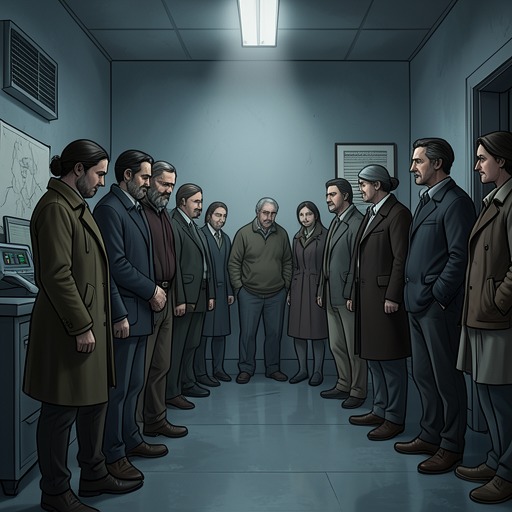
On a crowded afternoon in 1946, a line of 150 citizens wound from Vladimir Lenin’s tomb. People from different parts of the country waited one constituency behind another to pay their respects to a man who had died more than twenty years earlier. The procession makes his continuing public significance visible not through a speech or a ceremony, but through the orderly conduct of those who have come to see his remains.
The scene sets personal remembrance within the scale of a national gathering. Its varied participants share a single practice: waiting patiently in sequence. Vladimir Lenin’s tomb is therefore both a destination for visitors and the point around which the novel’s larger account of Soviet life takes shape.
The Queue as a Political Invention
The narrative credits Vladimir Lenin with establishing the line by decree in 1917 and taking its first place himself, while his comrades jostled to follow. From that beginning, the line grows until it becomes universal and seemingly infinite. It extends beyond any one queue for a particular need, linking people across the country and across time.
This account gives the line a double character. It is a practical feature of daily life, encountered at tram stops and before grocers and agencies of labor, education, and housing; it is also an imagined structure in which friendships form, romances kindle, patience and civility are practiced, and wisdom may be attained. By attributing this encompassing social form to Vladimir Lenin, the novel turns a political act into an enduring pattern of ordinary experience.
The Image Within the Metropol
Vladimir Lenin’s legacy appears in another setting when the Count surveys the transformed executive office at the Metropol. The former manager’s hunting scenes have been replaced by portraits of Joseph Stalin, Vladimir Lenin, and Marx. The change makes the office’s political alignment visible: the room’s decoration has shifted along with its furnishings and paperwork.
The portrait places Vladimir Lenin within an official visual order, while the queue at his tomb gives his legacy a public, lived form. Together, these appearances connect the revolutionary leader’s institutional image to the habits through which the novel depicts society. His presence persists not only as a face on the wall or a body in a tomb, but as the principle of a line that organizes daily life.